
Introduction
In the ever-evolving digital landscape of 2026, businesses face a critical question: How do potential customers find you online? With billions of searches happening every day, appearing in front of the right audience at the right time isn't just beneficial—it's essential for survival and growth.
Search Engine Optimization, commonly known by the SEO acronym, has transformed from a technical afterthought into a cornerstone of successful business strategy. Whether you're a local Montreal boutique, a regional service provider, or a company serving clients nationwide, your online visibility directly impacts your bottom line. The businesses thriving today aren't necessarily those with the biggest advertising budgets—they're the ones who understand how to harness the power of organic search.
What makes SEO particularly valuable in 2026 is its dual nature: it's both a science and an art. The science involves understanding how search engines work, what technical factors influence rankings, and how to measure success. The art comes in creating content that resonates with real people while satisfying algorithmic requirements. Many business owners feel overwhelmed by the complexity, but the fundamentals remain surprisingly accessible.
This comprehensive guide breaks down everything you need to know about SEO, from understanding the basic acronym to implementing strategies that drive real business results. You'll learn what SEO actually means, why it matters more than ever, and how to get started even if you're completely new to digital marketing. We'll explore the core components that make SEO work, the tangible benefits it brings to businesses, and practical steps you can take today to improve your online presence.
Whether you're considering handling SEO yourself or working with professionals, this guide gives you the knowledge to make informed decisions about your digital marketing strategy. Let's demystify SEO and discover how it can transform your business's online success.
Understanding the SEO Acronym
The SEO acronym stands for Search Engine Optimization—three simple words that represent a complex and powerful marketing discipline. At its core, this acronym describes the practice of improving your website and online presence to rank higher in search engine results pages, making it easier for potential customers to discover your business when they're actively searching for what you offer.
Let's break down each component of the SEO acronym. "Search Engine" refers to platforms like Google, Bing, and other tools people use to find information online. Google dominates the landscape with over 90% market share, which is why most SEO efforts focus primarily on understanding and working with Google's ranking systems. "Optimization" means making strategic improvements to increase performance—in this case, enhancing your website's ability to rank well for relevant searches.
The SEO acronym has become so embedded in business vocabulary that it's often used without explanation. Walk into any marketing meeting, and you'll hear phrases like "our SEO strategy" or "we need better SEO" thrown around casually. This widespread adoption reflects how essential search visibility has become to modern business operations.
Interestingly, the SEO acronym has evolved in meaning over the years. In the early 2000s, SEO primarily meant manipulating technical factors and building links to trick search engines into ranking websites higher. This led to spammy practices that degraded search quality. Today, the SEO acronym represents something far more sophisticated and ethical—creating genuinely valuable content and experiences that serve both users and search engines.
The evolution of the SEO acronym also reflects changes in how search engines work. Modern search algorithms use artificial intelligence and machine learning to understand user intent, content quality, and website authority in ways that would have seemed impossible two decades ago. This means that when we talk about SEO in 2026, we're discussing a mature discipline that requires understanding user psychology, content strategy, technical web development, and data analysis.
For business owners, understanding the SEO acronym is the first step toward leveraging its power. It's not just technical jargon—it's a framework for thinking about how customers discover businesses online. When you grasp what the SEO acronym truly represents, you can make better decisions about your digital marketing investments and understand why certain strategies work while others fail.
The beauty of the SEO acronym is that while the tactics evolve, the fundamental principle remains constant: make your website the best possible answer to what people are searching for, and search engines will reward you with visibility.
What Is SEO and Why Does It Matter?

SEO is the practice of improving your website's visibility in organic (non-paid) search engine results. When someone searches for products, services, or information related to your business, SEO helps ensure your website appears prominently in the results. Think of search engines as massive libraries, and SEO as the system that helps librarians recommend your book to people looking for specific information.
Search engines work through three primary processes: crawling, indexing, and ranking. Crawling is when search engine bots discover and scan web pages across the internet. Indexing involves storing and organizing the content found during crawling. Ranking is the process of ordering search results based on relevance and quality when someone performs a search. SEO influences all three processes, but especially ranking, by signaling to search engines that your content deserves to appear high in results.
The mechanics behind search engines are remarkably sophisticated. Google's algorithm considers hundreds of ranking factors when deciding which pages to show for any given search. These factors include content quality, website speed, mobile-friendliness, backlinks from other sites, user experience metrics, and countless others. The algorithm constantly evolves, with Google making thousands of updates annually to improve search quality and combat manipulation.
What makes SEO particularly important in 2026 is how people use search engines. Research shows that 68% of online experiences begin with a search engine, and 53% of all website traffic comes from organic search. When potential customers need something, their first instinct is to search for it online. If your business doesn't appear in those critical first-page results, you're essentially invisible to a massive pool of potential customers actively looking for what you offer.
The business value of SEO extends beyond just traffic numbers. Unlike other marketing channels where you're interrupting people with your message, SEO connects you with people already interested in what you provide. Someone searching for "web development services Montreal" has clear intent—they need web development services and are likely ready to evaluate providers. Appearing in those results puts you in front of high-quality leads at the perfect moment in their decision-making process.
SEO also provides compounding returns over time. While paid advertising stops generating results the moment you stop paying, SEO efforts build upon themselves. A well-optimized page that ranks highly can continue attracting visitors for months or years with minimal ongoing investment. This makes SEO one of the most cost-effective marketing strategies available to businesses of any size.
Quick question
Want to turn this into a real plan?
If you want expert help with strategy, design, development, marketing, or automation — we’ll recommend the fastest path forward for your goals.
For small and medium-sized businesses, SEO levels the playing field against larger competitors. You don't need a Fortune 500 budget to rank well—you need the right strategy, quality content, and technical optimization. A local business can outrank national chains for location-specific searches by focusing on local SEO tactics and creating genuinely helpful content for their community.
SEO Basics: Core Components
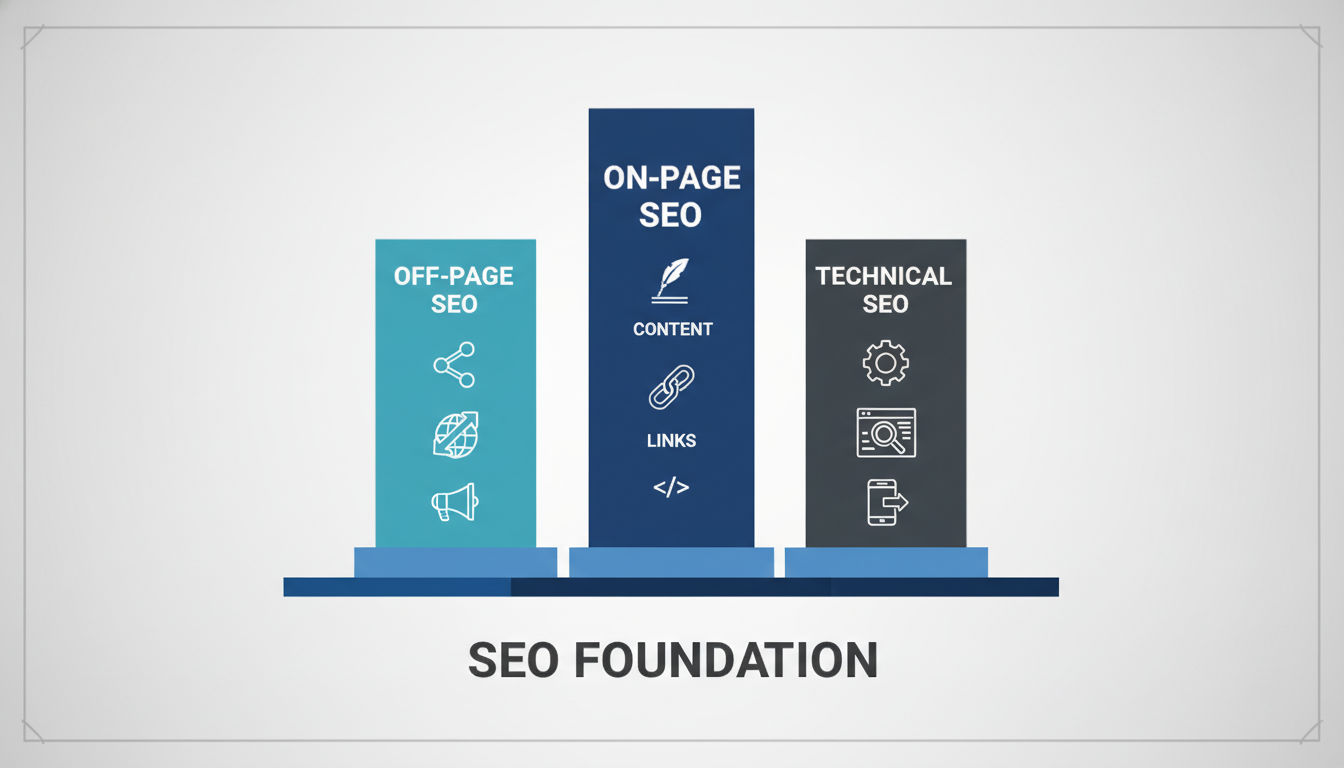
SEO consists of three interconnected pillars that work together to improve your search visibility: on-page SEO, off-page SEO, and technical SEO. Understanding these core components helps you build a comprehensive strategy that addresses all aspects of search optimization.
On-page SEO encompasses everything you control directly on your website. This includes optimizing your content with relevant keywords, crafting compelling title tags and meta descriptions, using header tags to structure content logically, and incorporating images with descriptive alt text. On-page SEO also involves creating high-quality, comprehensive content that thoroughly answers user questions and provides genuine value. The goal is to make each page as relevant and useful as possible for both search engines and human visitors.
Content optimization sits at the heart of on-page SEO. In 2026, search engines have become remarkably good at understanding content quality and user intent. Simply stuffing keywords into your pages no longer works—in fact, it can harm your rankings. Instead, effective content optimization means writing naturally for humans while strategically incorporating relevant terms and phrases. Your content should demonstrate expertise, provide unique insights, and be more comprehensive than competing pages on the same topic.
Off-page SEO refers to activities that happen outside your website but influence your rankings. The most important off-page factor is backlinks—links from other websites pointing to yours. Search engines view backlinks as votes of confidence; when reputable sites link to your content, it signals that your information is trustworthy and valuable. However, not all backlinks are created equal. A single link from a highly authoritative, relevant website carries more weight than dozens of links from low-quality sites.
Building a strong backlink profile requires creating content worth linking to and building relationships within your industry. This might involve publishing original research, creating comprehensive guides, guest posting on relevant blogs, or earning media coverage. The key is focusing on quality over quantity—a few excellent backlinks from respected sources will outperform hundreds of spammy links.
Technical SEO ensures that search engines can effectively crawl, index, and understand your website. This includes optimizing site speed, ensuring mobile-friendliness, implementing proper URL structures, creating XML sitemaps, and fixing broken links. Technical SEO also involves structured data markup, which helps search engines understand your content's context and can lead to enhanced search results with rich snippets.
In 2026, Core Web Vitals have become crucial technical SEO factors. These metrics measure real-world user experience, including loading performance, interactivity, and visual stability. Websites that provide excellent user experiences on these metrics receive ranking boosts, while those with poor performance may see rankings decline. This reflects Google's ongoing shift toward prioritizing user experience as a ranking factor.
Site architecture plays a vital role in technical SEO. A well-organized website with logical navigation helps both users and search engines find and understand your content. This means creating a clear hierarchy of pages, using internal linking strategically to connect related content, and ensuring that important pages are easily accessible from your homepage.
Security has also become a baseline technical requirement. Websites must use HTTPS encryption to protect user data. Search engines explicitly favor secure sites, and browsers now warn users when visiting non-secure sites, which can devastate trust and conversion rates.
The beauty of these core components is that they work synergistically. Great content (on-page SEO) attracts links (off-page SEO), while solid technical foundations ensure that search engines can effectively discover and rank that content. Neglecting any one pillar weakens your entire SEO strategy, which is why comprehensive approaches deliver the best results.
How SEO Benefits Your Business

The benefits of SEO extend far beyond simply appearing higher in search results—they fundamentally transform how businesses acquire and retain customers. Understanding these benefits helps justify the investment and effort required to implement effective SEO strategies.
Increased organic visibility represents the most obvious benefit. When your website ranks on the first page of search results for relevant queries, you dramatically increase the number of potential customers who discover your business. Research consistently shows that the top three organic search results receive the majority of clicks, with the first position alone capturing about 28% of all clicks. Even moving from position five to position three can double your traffic for a given keyword.
This visibility becomes particularly valuable when you consider search intent. People using search engines are actively seeking solutions, information, or products. They're not passively scrolling through social media or watching television—they're engaged in a goal-oriented behavior. When your business appears in these moments of high intent, you're connecting with prospects at the ideal time in their customer journey.
Cost-effective customer acquisition makes SEO especially attractive compared to other marketing channels. While SEO requires upfront investment in optimization, content creation, and potentially professional services, it doesn't require ongoing payments for each visitor or click. Once you achieve strong rankings, you receive continuous traffic without the per-click costs associated with paid advertising. Over time, this makes SEO one of the highest-ROI marketing strategies available.
Consider a Montreal-based business that ranks well for ten different search terms, each generating 100 visitors monthly. That's 1,000 monthly visitors at essentially no incremental cost per visitor. Achieving the same traffic through paid advertising might cost thousands of dollars monthly, and the traffic stops immediately when you stop paying. With SEO, those rankings continue generating value month after month.
Building brand credibility and trust represents a subtle but powerful SEO benefit. Consumers inherently trust organic search results more than paid advertisements. When your business appears prominently in organic results, it signals authority and legitimacy in your field. This perception of credibility extends beyond the search results page—visitors arriving from organic search are more likely to view your business as an established, trustworthy provider.
High search rankings also create a self-reinforcing cycle of authority. As you rank well and receive more visitors, you gain opportunities to earn more backlinks, social shares, and brand mentions. These signals further strengthen your SEO performance, leading to even better rankings. This compounding effect makes early SEO investments increasingly valuable over time.
Long-term marketing ROI distinguishes SEO from most other marketing channels. While paid advertising, social media campaigns, and other tactics typically deliver immediate but temporary results, SEO builds lasting value. A blog post that ranks well can continue attracting visitors for years. Technical improvements to your website benefit every page indefinitely. The authority you build through backlinks accumulates over time.
This long-term perspective is crucial for business planning. Companies that invest consistently in SEO create durable competitive advantages that become harder for competitors to overcome. While a competitor can match your advertising spend immediately, they cannot instantly replicate years of accumulated SEO authority, content, and rankings.
SEO also provides valuable market insights. The keyword research process reveals exactly what your potential customers are searching for, what questions they're asking, and what language they use. This intelligence informs not just your SEO strategy but your entire marketing approach, product development, and customer service. Understanding search trends helps you anticipate market shifts and customer needs before competitors recognize them.
SEO Business Strategy in 2026
Effective SEO in 2026 requires tight alignment with broader business objectives. The most successful companies don't treat SEO as a standalone tactic but integrate it into their overall growth strategy. This means identifying business goals first—whether that's increasing revenue, entering new markets, or building brand awareness—and then developing SEO initiatives that directly support those objectives.
Start by mapping your customer journey and identifying where search fits in. For some businesses, customers begin their journey with informational searches, gradually moving toward transactional queries as they near a purchase decision. For others, customers might use search primarily for local business discovery or post-purchase support. Understanding these patterns helps you prioritize which types of content and keywords deserve the most attention.
The competitive advantages of SEO become most apparent when you consider the barriers to entry. While a competitor can launch a comparable paid advertising campaign overnight, they cannot instantly replicate your accumulated SEO authority. Years of content creation, backlink building, and technical optimization create moats that protect your market position. This makes SEO particularly valuable for businesses operating in competitive industries where paid advertising costs have become prohibitively expensive.
SEO versus paid advertising represents one of the most common strategic decisions businesses face. The reality is that these channels work best together rather than as alternatives. Paid advertising delivers immediate results and precise targeting but requires continuous investment. SEO builds slowly but creates lasting value and trust. A balanced approach uses paid advertising for immediate needs and testing while building SEO assets for long-term sustainable growth.
Consider using paid advertising to identify which keywords and messages resonate with your audience, then creating SEO-optimized content around those winning themes. This approach combines the testing speed of paid channels with the lasting value of organic optimization. Many successful businesses gradually shift budget from paid to SEO as their organic presence strengthens, reducing overall customer acquisition costs while maintaining growth.
Measuring SEO success requires looking beyond vanity metrics like rankings and traffic. While these indicators matter, they're means to an end rather than goals themselves. Focus on business outcomes: leads generated, customers acquired, revenue attributed to organic search, and customer lifetime value from organic channels. These metrics demonstrate SEO's true business impact and justify continued investment.
Modern analytics platforms make attribution increasingly sophisticated. You can track how organic search visitors interact with your site, what conversion paths they follow, and how they compare to visitors from other channels. This data reveals not just whether SEO is working but how to optimize your strategy for better results. Perhaps organic visitors convert better on certain pages, or specific content types generate more qualified leads—these insights drive continuous improvement.
Setting realistic expectations is crucial for SEO success. Unlike paid advertising where you can see results immediately, SEO typically requires three to six months before significant results appear, and twelve months or more to reach full potential. This timeline reflects the time needed for search engines to crawl and index new content, for content to attract backlinks, and for authority signals to accumulate. Businesses that understand and accept this timeline avoid premature strategy abandonment.
However, this doesn't mean you should wait months to see any progress. Early indicators like improved crawl rates, indexed pages, and rankings for long-tail keywords provide evidence that your strategy is working. These leading indicators help maintain confidence during the lag time before traffic and conversions materialize.
For businesses serving specific geographic areas, local SEO creates particularly strong competitive advantages. A Montreal business optimizing for local search can dominate their geographic market even while national competitors have stronger overall domain authority. Local SEO involves optimizing your Google Business Profile, earning local citations, gathering customer reviews, and creating location-specific content. These tactics help you appear in the crucial "local pack" results and Google Maps, where many customer journeys begin.
Getting Started with SEO

Beginning your SEO journey can feel overwhelming, but breaking it into manageable steps makes the process approachable. The first step is conducting an SEO audit of your current website to understand where you stand. This involves analyzing your site's technical health, content quality, backlink profile, and current rankings. Free tools like Google Search Console provide valuable baseline data about how search engines currently view your site.
Essential SEO tools form the foundation of any optimization effort. Google Search Console and Google Analytics are free, powerful platforms that provide insights into your site's performance, search traffic, and user behavior. These tools show which queries bring visitors to your site, how users interact with your content, and technical issues that need attention. Beyond these basics, keyword research tools help identify opportunities, while SEO platforms provide comprehensive data about rankings, backlinks, and competitors.
The DIY SEO versus professional services decision depends on your resources, expertise, and business priorities. Basic SEO principles are accessible to anyone willing to learn—you can absolutely handle fundamental optimization yourself. This includes writing quality content, optimizing title tags and meta descriptions, improving site speed, and building a basic backlink profile. Many small businesses successfully manage their own SEO, particularly in the early stages.
However, professional SEO services become valuable as your needs grow more complex. Experts bring specialized knowledge about technical optimization, advanced link building strategies, and algorithm updates that might take years to develop independently. They also provide objectivity and dedicated focus that busy business owners often struggle to maintain. For businesses in competitive markets or those with significant growth goals, professional guidance can dramatically accelerate results and avoid costly mistakes.
A hybrid approach works well for many businesses. Handle content creation and basic optimization internally while consulting professionals for technical audits, strategy development, and complex implementations. This balances cost-effectiveness with expert guidance, ensuring you build on solid foundations while maintaining control over your content and brand voice.
Next step
Ready for a quote and timeline?
Send a quick note with what you’re building, your deadline, and what success looks like — we’ll reply with clear next steps.
Creating your first SEO strategy starts with keyword research. Identify the terms and phrases your potential customers use when searching for your products or services. Focus initially on long-tail keywords—longer, more specific phrases that face less competition and attract highly qualified traffic. A web development company might target "custom e-commerce website development for Montreal retailers" rather than just "web development," which faces enormous competition.
Once you've identified target keywords, conduct a content gap analysis. Compare your existing content against top-ranking competitors for your target keywords. What topics do they cover that you don't? How comprehensive is their content compared to yours? This analysis reveals opportunities to create superior content that deserves to rank well.
Prioritize quick wins alongside long-term initiatives. Quick wins might include fixing technical errors, optimizing existing high-traffic pages, or claiming and optimizing your Google Business Profile. These actions can deliver relatively fast results that build momentum. Simultaneously, begin creating comprehensive content and building relationships for backlinks—initiatives that take longer but create lasting value.
Common mistakes to avoid include keyword stuffing, buying backlinks, duplicating content, neglecting mobile optimization, and ignoring user experience. These tactics either no longer work or actively harm your rankings. Modern SEO rewards websites that genuinely serve users rather than trying to manipulate algorithms. Focus on creating the best possible experience for visitors, and optimization will follow naturally.
Another frequent mistake is inconsistency. SEO requires sustained effort over time rather than sporadic bursts of activity. Publishing ten blog posts in one month then nothing for six months delivers far worse results than publishing two posts monthly consistently. Search engines reward websites that regularly publish fresh, quality content and maintain their technical health.
Don't neglect the basics while chasing advanced tactics. Ensuring your website loads quickly, works flawlessly on mobile devices, and has clear navigation matters more than sophisticated schema markup or complex technical implementations. Master fundamentals before pursuing advanced strategies.
Finally, remember that SEO is ultimately about serving people, not algorithms. When facing any optimization decision, ask yourself whether it improves the user experience. If a tactic helps visitors find information faster, understand your content better, or accomplish their goals more easily, it's probably good SEO. If it's purely for search engines with no user benefit, it's probably not worth doing.
Conclusion
Understanding what SEO means and how it works represents a crucial advantage for businesses competing in 2026's digital marketplace. The SEO acronym encompasses far more than technical jargon—it represents a comprehensive approach to connecting with customers at the exact moment they're searching for solutions you provide. From the fundamentals of on-page optimization to the strategic value of long-term organic visibility, SEO offers unmatched opportunities for sustainable business growth.
The core components of SEO—on-page optimization, off-page authority building, and technical excellence—work together to create a strong foundation for online success. While each element requires attention, the synergy between them produces results greater than the sum of their parts. Businesses that master these basics position themselves to capture high-intent traffic, build lasting brand authority, and achieve marketing ROI that compounds over time.
What makes SEO particularly valuable is its democratic nature. Unlike traditional advertising where budget determines reach, SEO rewards businesses that genuinely serve their audience with quality content and excellent user experiences. A small Montreal business with the right strategy can outrank national competitors for valuable local searches. This levels the playing field and creates opportunities for companies of all sizes to compete effectively in their markets.
The business benefits of SEO extend beyond traffic metrics. Increased organic visibility translates directly to cost-effective customer acquisition, with visitors arriving at precisely the moment they need your services. The credibility that comes from strong organic rankings builds trust that paid advertising simply cannot replicate. Most importantly, SEO creates lasting value that continues generating returns long after the initial investment, making it one of the most efficient marketing strategies available.
Getting started with SEO doesn't require massive budgets or technical expertise—it requires commitment to understanding your audience, creating valuable content, and consistently implementing best practices. Whether you choose to handle SEO internally, work with professionals, or adopt a hybrid approach, the key is beginning with solid foundations and maintaining consistent effort over time. Quick wins provide early momentum while long-term strategies build the authority that sustains success.
As you move forward with implementing SEO for your business, remember that the landscape constantly evolves. Search engines refine their algorithms, user behavior shifts, and new technologies emerge. Staying informed about these changes while maintaining focus on fundamental principles—creating value for users, building authority, and ensuring technical excellence—keeps your strategy effective regardless of specific algorithm updates.
The investment you make in SEO today builds assets that serve your business for years to come. Every piece of optimized content, every earned backlink, and every technical improvement contributes to a stronger online presence that becomes increasingly difficult for competitors to overcome. This compounding effect makes starting now, rather than waiting, crucial for long-term success.
For businesses ready to harness the power of SEO but uncertain about the best approach, professional guidance can dramatically accelerate results while avoiding costly mistakes. At Vohrtech, we specialize in helping businesses develop and implement SEO strategies that align with their unique goals and market positions. Our evidence-based approach combines technical expertise with content strategy to deliver measurable results that impact your bottom line.
Whether you're just beginning to explore SEO or looking to enhance existing efforts, the next step is taking action. Start with an honest assessment of your current online presence, identify your most valuable opportunities, and develop a plan that balances quick wins with long-term growth. The businesses that thrive in 2026's digital landscape won't be those with the biggest advertising budgets—they'll be those that understand how to leverage organic search to connect with customers when it matters most.
Ready to develop an SEO strategy that drives real business results? Visit our services page to explore how we help businesses improve their online visibility, or contact us to discuss your specific needs and goals. You can also check out our projects page to see how we've helped other businesses achieve SEO success. The opportunity to transform your online presence starts with understanding what SEO truly means—and taking that first step toward implementation.