Introduction
Building a successful startup means making smart choices with limited resources. One of the most critical decisions you'll face is how to develop your first product. Should you build everything at once or start small and test the waters?
This is where MVP development comes into play. An MVP, or Minimum Viable Product, lets you launch faster, spend less money, and learn what your customers actually want before investing heavily in full-scale development. Think of it as testing the recipe before opening a restaurant.
Many startups fail because they spend months or years building a product nobody wants. They add feature after feature, drain their budget, and launch to crickets. The MVP approach flips this script entirely. You build just enough to solve your customers' core problem, get it into their hands quickly, and use their feedback to guide what comes next.
Strategic planning makes the difference between an MVP that succeeds and one that falls flat. You can't just throw together a basic version of your idea and hope for the best. You need a clear roadmap that identifies your target users, defines your core value proposition, and sets measurable goals for success.
The good news? You don't need a massive team or unlimited funding to build an effective MVP. With the right development strategies, even bootstrapped startups can create products that resonate with users and attract investors. Whether you're a first-time founder or an experienced entrepreneur, understanding how to approach MVP development will dramatically increase your chances of building something people actually want to use.
This guide walks you through proven strategies for planning, building, and launching an MVP that sets your startup up for long-term success.
Understanding MVP Development Fundamentals
An MVP is the simplest version of your product that can still deliver value to early users. It's not a prototype or a demo. It's a real, working product that solves a specific problem for a specific group of people.
The key word here is "viable." Your MVP needs to work well enough that people will actually use it and pay for it. If it's too basic or buggy, users won't stick around to see it improve. But it also shouldn't include every feature you've ever dreamed of adding.
Defining the Minimum Viable Product Approach
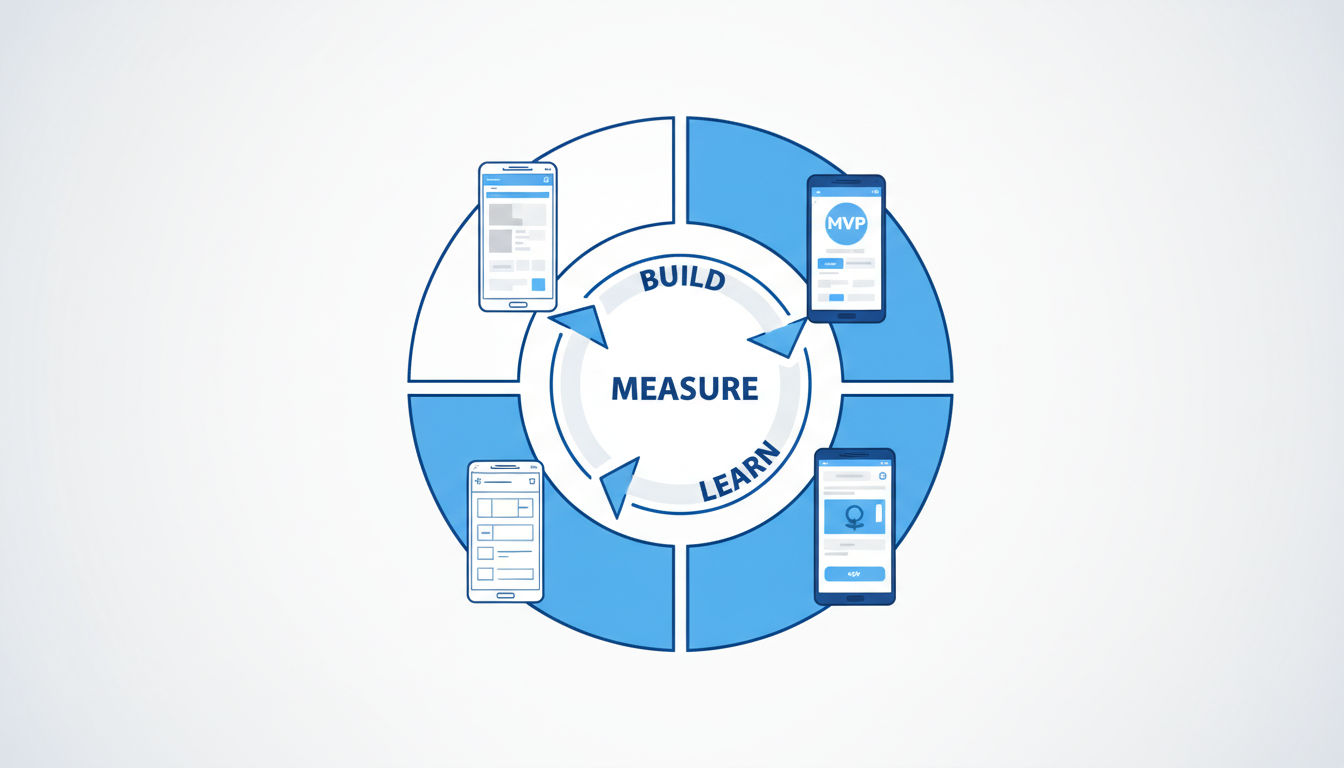
The MVP concept was popularized by Eric Ries in his book "The Lean Startup." The core idea is simple: build, measure, learn, and repeat. You create the smallest version of your product that lets you start this learning cycle.
Your MVP should focus on one core feature or use case. If you're building a food delivery app, your MVP might only work in one neighborhood with five restaurants. If you're creating project management software, it might only handle basic task lists without advanced reporting or integrations.
This approach forces you to identify what really matters to your users. It strips away assumptions and nice-to-have features, leaving only what's essential. Many successful companies started with incredibly simple MVPs. Airbnb began with the founders renting out air mattresses in their apartment. Dropbox launched with just a simple video showing how file syncing would work.
Key Principles of Startup Development
Speed matters more than perfection in the early stages. Your first version won't be perfect, and that's okay. The goal is to get something functional into users' hands as quickly as possible so you can start learning.
Focus on solving one problem exceptionally well rather than solving many problems poorly. Users will forgive a limited feature set if what you do offer works brilliantly. They won't forgive a bloated product that does everything badly.
Build for your early adopters, not everyone. Your MVP targets a specific segment of users who feel the pain point most acutely. These early adopters are more forgiving of rough edges and more willing to provide feedback. They become your partners in shaping the product.
Measure everything from day one. Set up analytics and feedback mechanisms before you launch. You need data to make informed decisions about what to build next. Without measurements, you're just guessing.
Benefits of MVP Over Full-Scale Product Launches
The financial advantage is obvious. Building an MVP costs a fraction of what a full product launch requires. Instead of spending $200,000 on a complete platform, you might spend $20,000 to $50,000 on an MVP. This conserves your runway and gives you more time to find product-market fit.
Risk reduction is equally important. Every feature you build based on assumptions rather than user feedback represents a risk. The MVP approach minimizes this risk by validating your core assumptions before you invest heavily.
You'll reach the market faster with an MVP. While competitors spend 18 months building their "perfect" product, you can launch in three to six months. This speed advantage lets you start building a user base, generating revenue, and establishing your brand earlier.
Learning happens in real-world conditions. User feedback from an actual product is infinitely more valuable than opinions from focus groups or surveys. You'll discover what users really need, how they actually use your product, and what features matter most.
Investor appeal increases when you have a working product with real users. An MVP with even modest traction is far more compelling than a detailed business plan and mockups. You're no longer asking investors to bet on an idea. You're showing them early proof that your concept works.
The iterative nature of MVP development means you can pivot quickly if needed. If you discover your initial approach isn't working, you haven't wasted years of development time. You can adjust your strategy based on real data and user feedback.
Planning Your MVP Development Strategy
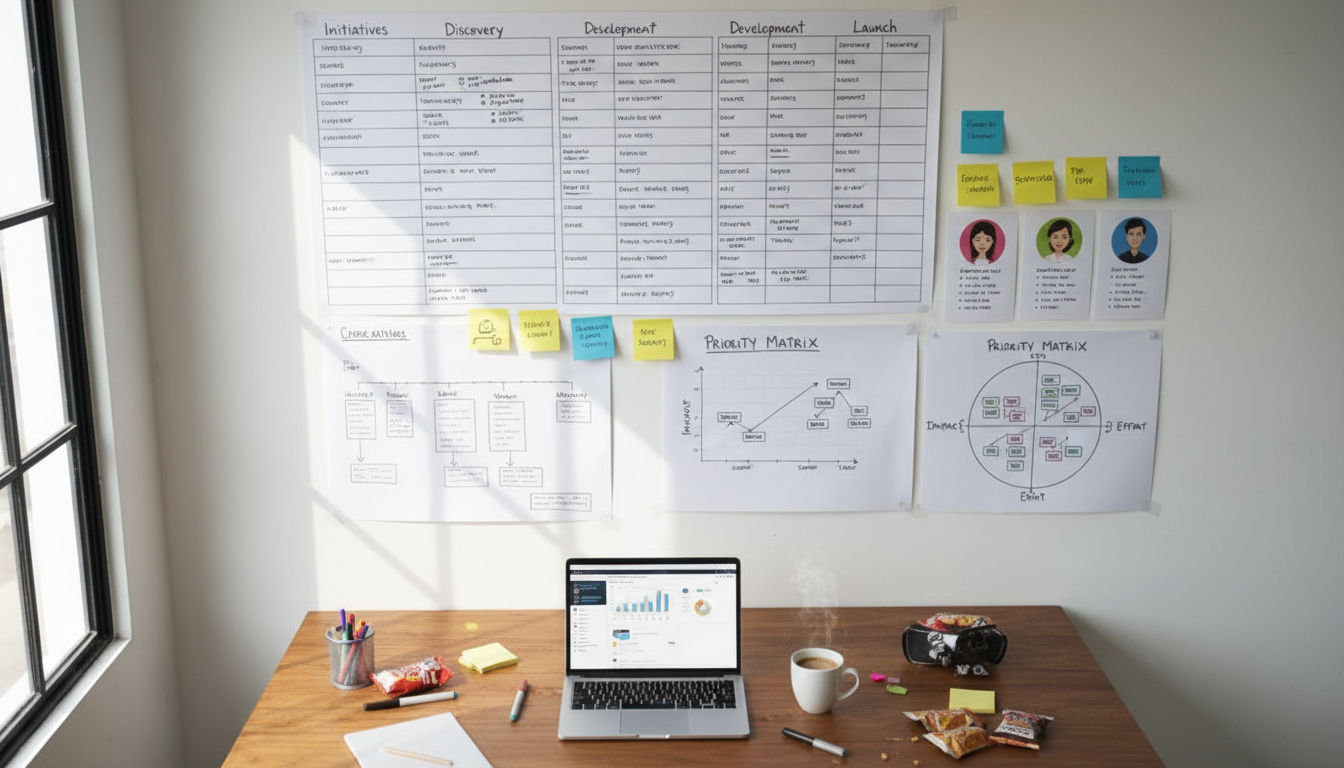
Successful MVP development starts long before you write a single line of code. The planning phase determines whether you build something users want or waste resources on features nobody needs.
Identifying Your Core Value Proposition
Your value proposition answers one question: why should someone use your product instead of what they're doing now? This needs to be crystal clear before you start building.
Start by identifying the specific problem you're solving. Don't say "communication is hard." Say "remote teams waste 30 minutes daily searching for information scattered across emails and chat messages." The more specific you are, the easier it becomes to design a solution.
Your value proposition should be expressible in one sentence. If you can't explain what makes your product valuable in 10 seconds, you don't understand it well enough yet. This clarity guides every decision you make during development.
Research how your target users currently solve this problem. Are they using spreadsheets? Emailing back and forth? Using a competitor's product? Understanding their current solution helps you identify what your MVP must do to convince them to switch.
Defining Target Users and Market Validation
You can't build for everyone, especially not with an MVP. You need to identify a specific segment of users who feel your problem most acutely and are most likely to try a new solution.
Create detailed user personas. Go beyond demographics to understand their behaviors, motivations, and pain points. What does their typical day look like? What frustrates them about current solutions? What would make them willing to try something new?
Talk to potential users before you build anything. Conduct at least 20 to 30 interviews with people who fit your target profile. Ask about their current challenges, how they've tried to solve them, and what features would be most valuable. These conversations often reveal that your assumptions were wrong, saving you from building the wrong thing.
Market validation means confirming that enough people have this problem and are willing to pay for a solution. Look for signs of demand: existing competitors, people paying for inadequate solutions, or active online communities discussing the problem.
Consider starting with an even narrower niche for your MVP. Instead of targeting "small businesses," target "boutique fitness studios in urban areas." This specificity makes it easier to reach your initial users and tailor your product to their needs.
Setting Clear Goals and Success Metrics
Define what success looks like for your MVP before you launch. These metrics guide your development priorities and help you decide when to pivot or persevere.
Choose metrics that reflect real value, not vanity numbers. Downloads and signups are less meaningful than active users, retention rates, and revenue. If users sign up but never come back, your MVP isn't solving their problem effectively.
Set realistic targets based on your industry and stage. For a B2C app, you might aim for 1,000 active users with 40% weekly retention. For a B2B SaaS product, 20 paying customers might be your initial goal. Research similar products to understand what's achievable.
Establish a timeline for hitting these metrics. Give yourself three to six months after launch to reach your initial targets. This deadline creates urgency and helps you decide when it's time to make significant changes.
Track both quantitative and qualitative metrics. Numbers tell you what's happening, but user feedback tells you why. Combine analytics with regular user interviews to get the full picture.
Budget and Timeline Considerations
Most startups underestimate both the cost and time required for MVP development. Realistic planning prevents you from running out of resources before you can validate your concept.
MVP development typically costs between $15,000 and $75,000, depending on complexity. A simple mobile app might cost $20,000 to $40,000, while a more complex web platform could run $50,000 to $100,000. Get detailed quotes from development teams before committing to a scope.
Quick question
Want to turn this into a real plan?
If you want expert help with strategy, design, development, marketing, or automation — we’ll recommend the fastest path forward for your goals.
Development timelines usually range from two to six months. A basic MVP with one core feature might take eight to twelve weeks. More complex products with multiple integrated features could take four to six months. Factor in time for testing and bug fixes, which often takes longer than expected.
Plan for post-launch costs too. You'll need resources for hosting, maintenance, user support, and iterative improvements based on feedback. Budget at least 20% to 30% of your initial development cost for the first three months after launch.
Consider your funding runway when planning your MVP. If you have 12 months of funding, spending nine months on development leaves little time for iteration and growth. A better approach might be launching a simpler MVP in four months, giving you eight months to learn and improve.
Break your development into phases if budget is tight. Launch with the absolute minimum first, then add features based on user feedback and additional funding. This phased approach reduces initial costs and ensures you're building what users actually want.
Essential Features vs. Nice-to-Have Features
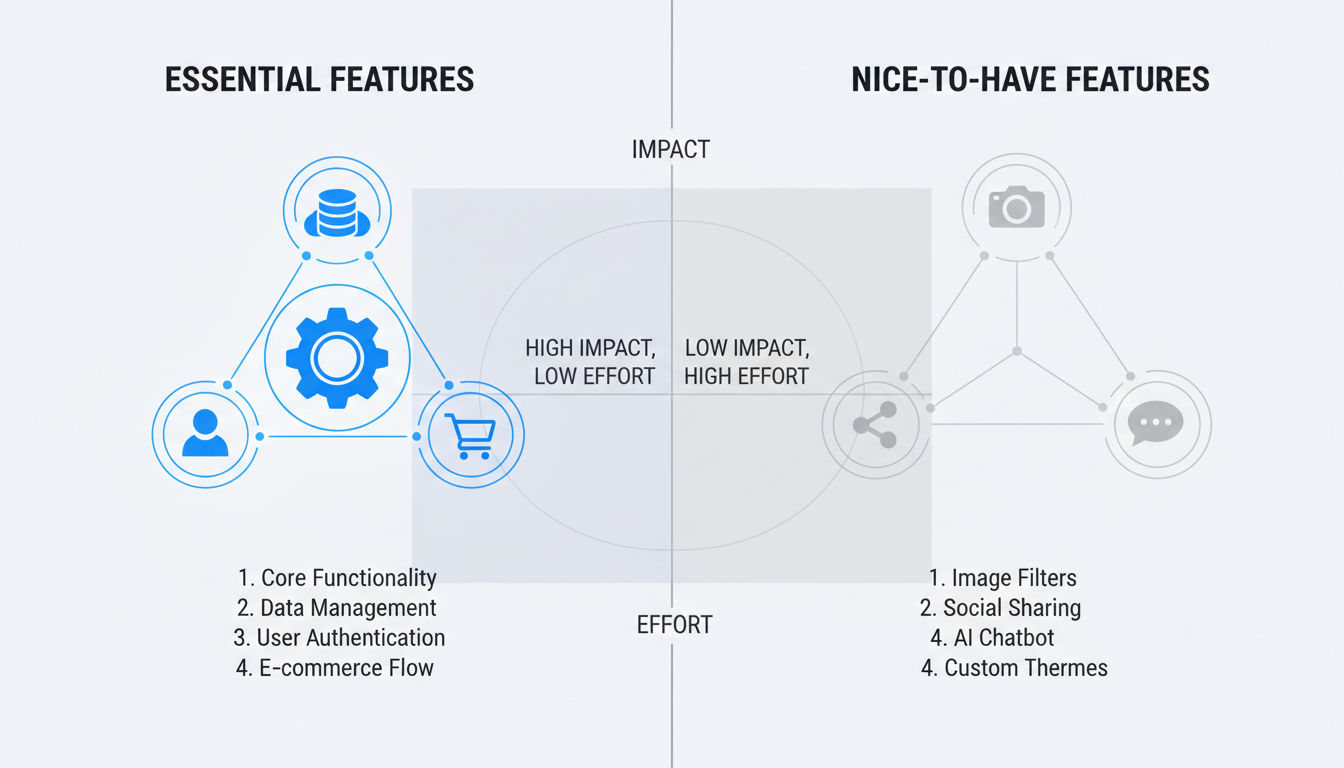
The hardest part of MVP development is deciding what to include and what to cut. Every feature seems important when you're excited about your idea, but overbuilding is one of the top reasons MVPs fail.
The Feature Prioritization Framework
Start by listing every feature you've imagined for your product. Don't hold back during this brainstorming phase. Write down everything, from core functionality to wild ideas you might implement someday.
Now comes the tough part: categorizing these features. Use a simple framework with three categories. "Must-have" features are absolutely essential for the product to deliver its core value. "Should-have" features would enhance the experience but aren't critical for launch. "Nice-to-have" features would be cool but don't significantly impact the core value proposition.
For each feature, ask yourself: "Can we deliver our core value proposition without this?" If the answer is yes, it's not a must-have. Be ruthless in this evaluation. Most founders initially categorize too many features as must-haves.
Consider the impact versus effort for each feature. A feature that takes three weeks to build but only marginally improves the user experience probably isn't worth including in your MVP. Focus on high-impact features that can be built relatively quickly.
Use the MoSCoW method to add more nuance: Must have, Should have, Could have, Won't have (for now). This framework forces you to make explicit decisions about priority rather than leaving everything in a vague "we'll see" category.
How to Determine Your MVP's Core Functionality
Your core functionality is the one thing your product does that solves your users' primary problem. Everything else is secondary. To identify this, return to your value proposition and user research.
Ask your target users what feature they'd want if they could only have one. Their answers might surprise you. Founders often assume certain features are critical when users care about something entirely different.
Look at your competitors' products and identify what users complain about most. Sometimes the core functionality isn't about adding something new but doing an existing thing much better. Slack didn't invent team chat, but they made it dramatically easier and more pleasant to use.
Create user stories that describe how people will use your MVP. Start with "As a [user type], I want to [action] so that [benefit]." If a feature doesn't appear in your top three to five user stories, it's probably not core functionality.
Build a prototype or wireframe showing just the core features. Show it to potential users and watch how they interact with it. If they can accomplish their main goal without asking for additional features, you've identified your core correctly.
Remember that core functionality can be surprisingly simple. Instagram started as a photo-sharing app with filters. That's it. No stories, no reels, no shopping. The core was simple, but it solved a real problem well enough to attract millions of users.
Avoiding Feature Creep in Early Development
Feature creep happens when you keep adding "just one more thing" during development. It's one of the biggest threats to successful MVP launches because it delays your launch date and inflates costs.
Establish a feature freeze date early in your planning. After this date, no new features get added until after launch. This discipline keeps your team focused and prevents the endless "wouldn't it be cool if" conversations.
Create a backlog for future features instead of adding them to your MVP. When someone suggests a new feature, acknowledge it's a good idea and add it to your post-launch roadmap. This validates the suggestion without derailing your current plan.
Remember that every feature you add increases complexity exponentially. Each new feature needs to work with every existing feature, creating more potential bugs and user confusion. A product with three features is more than twice as simple as one with six.
User feedback will often request features you've already planned. Resist the urge to add them immediately. Wait until after launch to see if multiple users request the same thing. One user's "must-have" feature might be irrelevant to everyone else.
Set up a decision-making framework for evaluating new feature requests during development. Any addition must be approved by the product owner and must not extend the launch timeline. If it adds more than a few days of work, it automatically goes into the post-launch backlog.
Stay focused on your launch date. Every week you delay launching is another week you're not learning from real users. A good-enough MVP launched today is better than a perfect product launched in six months.
Choosing the Right Development Approach
How you build your MVP matters almost as much as what you build. The right development approach balances speed, cost, and quality while setting you up for future growth.
In-House vs. Outsourced Development Teams
Building in-house gives you complete control and builds long-term technical capacity for your startup. If you have a technical co-founder or can hire experienced developers, this approach makes sense. Your team will deeply understand your product and can iterate quickly based on user feedback.
However, hiring developers is expensive and time-consuming. A senior developer in Montreal might cost $80,000 to $120,000 annually, plus benefits and equipment. For early-stage startups, this represents a significant portion of your budget before you've validated your concept.
Outsourcing to a development agency can dramatically reduce your initial costs and time to market. Experienced agencies have built dozens of MVPs and know how to avoid common pitfalls. They can assemble a team quickly and start building within weeks rather than months.
The downside of outsourcing is less direct control and potential communication challenges. You need to find a reliable partner who understands your vision and can translate it into working software. Poor agency selection leads to missed deadlines, cost overruns, and subpar products.
A hybrid approach works well for many startups. Outsource the initial MVP development while hiring one technical person who can manage the relationship and eventually take over maintenance and improvements. This gives you the speed of outsourcing with a path toward building internal capability.
Consider your timeline when making this decision. If you need to launch in three months, outsourcing is probably your best option. If you have six to nine months and enough funding, building in-house might work. The key is being realistic about how long hiring and onboarding takes.
Agile Methodology for MVP Development
Agile development is practically synonymous with MVP creation. This methodology emphasizes iterative development, regular feedback, and flexibility over rigid long-term planning.
In Agile, you break development into short cycles called sprints, typically lasting two weeks. Each sprint delivers a working piece of functionality that can be tested and reviewed. This approach lets you see progress quickly and make adjustments as you learn more about what works.
Start each sprint with planning where you decide what features or improvements to tackle. End with a review where you demonstrate the new functionality and gather feedback. This regular rhythm keeps everyone aligned and prevents surprises at the end of development.
Daily stand-up meetings keep the team synchronized. Each team member briefly shares what they completed yesterday, what they're working on today, and any obstacles they're facing. These 15-minute meetings prevent small issues from becoming big problems.
Agile requires close collaboration between developers and stakeholders. You can't hand off requirements and disappear for three months. Plan to be actively involved throughout development, answering questions and providing feedback.
Use tools like Jira, Trello, or Asana to manage your development backlog and track progress. These platforms let you see what's being worked on, what's completed, and what's coming next. Transparency prevents misunderstandings and keeps everyone accountable.
The biggest advantage of Agile for MVPs is flexibility. When you discover that a planned feature isn't as important as you thought, you can adjust your priorities for the next sprint. This adaptability is crucial when you're still figuring out exactly what users need.
Technology Stack Selection for Startups
Your technology stack includes all the programming languages, frameworks, databases, and tools used to build your product. Choosing the right stack impacts development speed, costs, and your ability to scale later.
Prioritize proven, popular technologies over cutting-edge options for your MVP. Mainstream technologies like React for front-end, Node.js or Python for back-end, and PostgreSQL for databases have large communities, extensive documentation, and plenty of available developers.
Consider your development team's expertise when selecting technologies. If you're outsourcing to an agency, ask what they're most experienced with. Building with their preferred stack will be faster and cheaper than forcing them to use something unfamiliar.
Think about future hiring when choosing your stack. If you plan to build an in-house team eventually, select technologies that have strong talent pools in your area. In Montreal, for example, JavaScript, Python, and React developers are relatively abundant.
Cloud platforms like AWS, Google Cloud, or Heroku simplify infrastructure management for MVPs. They let you start small and scale up as needed without huge upfront investments in servers. Many offer free tiers or startup credits that reduce your initial hosting costs.
Mobile app development requires choosing between native development (Swift for iOS, Kotlin for Android) or cross-platform frameworks like React Native or Flutter. Cross-platform development lets you build for both iOS and Android simultaneously, cutting development time and costs by 30% to 40%.
Don't over-engineer your MVP's architecture. You don't need microservices, complex caching layers, or elaborate deployment pipelines for your first version. Start with a simple, monolithic architecture that's easy to understand and modify. You can refactor and optimize once you've validated your concept and secured more funding.
Choose technologies that support rapid iteration. The easier it is to make changes and deploy updates, the faster you can respond to user feedback. This speed is more valuable than theoretical performance advantages you won't need until you have thousands of users.
Building and Testing Your Minimum Viable Product

The development phase is where your planning becomes reality. Success depends on maintaining focus, testing continuously, and staying flexible as you learn what works and what doesn't.
Development Phase Best Practices
Start with a detailed technical specification that translates your feature requirements into concrete development tasks. This document should include user flows, data models, API endpoints, and UI mockups. Clear specifications prevent miscommunication and scope creep.
Set up your development environment and deployment pipeline from day one. Automated testing and continuous integration catch bugs early and make it easy to push updates. Even for an MVP, basic DevOps practices save time and headaches later.
Build in vertical slices rather than horizontal layers. Instead of completing the entire database layer, then the entire backend, then the entire frontend, build one complete feature at a time. This approach delivers working functionality faster and makes it easier to test with real users.
Maintain regular communication with your development team through daily check-ins and weekly reviews. Address blockers immediately rather than letting them derail your timeline. If you're working with an outsourced team, schedule calls at times that work for both time zones.
Document your code and architecture as you build. Future developers (including your current team six months from now) will thank you. Good documentation makes it easier to onboard new team members and troubleshoot issues.
Prioritize security and data privacy from the start. Even an MVP needs secure authentication, encrypted data transmission, and protection against common vulnerabilities. Security breaches destroy trust and can be fatal for early-stage startups.
Rapid Prototyping Techniques
Prototyping lets you test ideas quickly before committing to full development. Create clickable mockups using tools like Figma, Adobe XD, or Sketch to visualize user flows and gather feedback.
Low-fidelity prototypes work great for testing core concepts and user flows. Simple wireframes or paper sketches help you validate ideas without investing in detailed designs. Show these to potential users and watch how they navigate through your proposed interface.
High-fidelity prototypes look and feel like the real product but don't have working backend functionality. These are useful for user testing and investor demos. They let people experience your product's interface without waiting for full development.
No-code and low-code platforms like Bubble, Webflow, or Airtable can create functional prototypes in days rather than weeks. For some MVPs, these platforms might be sufficient for your entire first version. They're particularly useful for validating demand before investing in custom development.
A/B testing different approaches during prototyping saves development time. If you're unsure whether users prefer a dashboard view or a list view, create mockups of both and test them with your target audience. Their feedback guides your development priorities.
Remember that prototypes are disposable. Don't get too attached to your initial designs. The goal is learning, not creating something perfect. If testing reveals that your approach won't work, it's better to discover this during prototyping than after spending weeks on development.
User Testing and Feedback Collection
Start testing with real users as soon as you have working functionality, even if it's incomplete. Early feedback prevents you from building in the wrong direction and wasting resources on features users don't want.
Recruit beta testers from your target audience. Aim for 10 to 20 users who represent your ideal customer profile. Offer them free access or other incentives in exchange for regular feedback and patience with bugs.
Create structured testing sessions where you observe users interacting with your product. Don't tell them how to use it. Watch where they get confused, what features they ignore, and what problems they encounter. Their struggles reveal usability issues you've overlooked.
Use analytics tools like Google Analytics, Mixpanel, or Amplitude to track how users interact with your MVP. Monitor which features get used most, where users drop off, and how long they stay engaged. Quantitative data complements qualitative feedback from interviews.
Set up feedback mechanisms directly in your product. A simple feedback button or in-app survey makes it easy for users to share their thoughts without leaving the application. You'll get more responses when you reduce friction.
Conduct regular user interviews throughout development and after launch. Schedule 30-minute calls with users to discuss their experience, what value they're getting, and what improvements they'd like to see. These conversations often reveal insights that analytics miss.
Create a system for organizing and prioritizing feedback. Not all user requests are equally important or aligned with your vision. Look for patterns in feedback rather than reacting to every individual suggestion. If multiple users mention the same issue, it's probably worth addressing.
Iterative Improvements Based on Data
Plan for rapid iteration cycles after your initial launch. Successful MVPs evolve quickly based on user behavior and feedback. Set up two-week iteration cycles where you implement improvements, test them, and gather new feedback.
Prioritize fixes and improvements based on impact and effort. Quick wins that significantly improve user experience should come first. Major features that require weeks of development should wait until you've validated that users actually want them.
Track your success metrics after each iteration to see if changes are working. If you modify your onboarding flow, did it improve activation rates? If you add a new feature, do users actually use it? Data tells you whether your changes are moving you toward your goals.
Don't be afraid to remove features that aren't working. If analytics show that nobody uses a particular feature, consider removing it to simplify your product. Fewer, better features often create a better user experience than lots of mediocre ones.
Balance user requests with your product vision. Users are great at identifying problems but not always at proposing solutions. If users say they want feature X, dig deeper to understand what problem they're trying to solve. You might find a better solution than what they suggested.
Communicate changes to your users. Send update emails or in-app notifications when you add new features or fix major issues. This shows users that you're listening and actively improving the product, which increases loyalty and engagement.
Launching Your MVP to Market
A successful launch requires careful preparation and realistic expectations. Your MVP launch isn't a one-time event but the beginning of an ongoing process of learning and improvement.
Pre-Launch Preparation Strategies
Build anticipation before your launch date by creating a landing page and collecting email signups from interested users. This gives you an audience to notify when you're ready to launch and provides early validation of interest.
Prepare your support infrastructure before users arrive. Set up help documentation, FAQ pages, and a system for handling support requests. Even with a small user base, you need to respond quickly to questions and issues.
Test everything multiple times before launch. Create a checklist of all critical functionality and have multiple people test it on different devices and browsers. Bugs that slip through to launch day create terrible first impressions.
Set up your analytics and tracking before launch so you capture data from day one. Define your key events and conversion funnels in advance. You can't make data-driven decisions if you're not collecting the right data.
Create launch materials including social media posts, email announcements, and any press releases. Write blog posts explaining your product's value proposition and how to get started. Good launch content helps users understand what you've built and why they should care.
Next step
Ready for a quote and timeline?
Send a quick note with what you’re building, your deadline, and what success looks like — we’ll reply with clear next steps.
Reach out to your network personally before launch. Send individual messages to people who expressed interest during your research phase. Personal outreach converts better than mass announcements and gives you early users who are invested in your success.
Soft Launch vs. Full Launch Approaches
A soft launch releases your MVP to a limited audience before opening it to everyone. This approach lets you work out bugs and gather feedback in a lower-stakes environment. Many successful products soft-launched to a single city or user segment before expanding.
Soft launches work well when you want to validate your product with a specific niche before targeting a broader market. If you're building a tool for Montreal restaurants, launch with 10 local establishments before expanding to other cities. Their feedback helps you refine the product for a wider rollout.
Full launches make sense when you've already validated your concept through prototypes and pre-orders. If you have a waiting list of users eager to try your product, a full launch captures that momentum. Just ensure your infrastructure can handle the traffic.
Consider your support capacity when choosing your approach. A soft launch with 50 users is manageable for a small team. A full launch that brings 500 users in the first week requires more robust support systems and might overwhelm you.
Product Hunt, Hacker News, and similar platforms can drive significant traffic but work better for full launches. These communities expect polished products and can be harsh on buggy MVPs. Save these channels for when you're confident in your product's stability.
Geographic soft launches work well for location-based services or when you need to manage supply and demand. Uber and Airbnb both launched in single cities before expanding. This approach lets you perfect your operations before scaling.
Initial Marketing and User Acquisition
Focus on channels where your target users already spend time. If you're targeting developers, GitHub, Stack Overflow, and developer-focused newsletters make sense. For small business owners, LinkedIn and industry-specific forums might work better.
Content marketing builds long-term value but takes time to show results. Start creating helpful content related to your product's problem space before launch. Blog posts, videos, and guides that solve real problems attract your target audience and establish your expertise.
Leverage your personal and professional networks for initial users. Share your launch with friends, former colleagues, and social media connections. Ask them to try your product and share it with others who might benefit.
Paid advertising can jumpstart user acquisition but requires careful budget management. Start with small campaigns on platforms like Google Ads, Facebook, or LinkedIn. Test different audiences and messages to find what works before scaling spending.
Partnerships with complementary products or services can provide access to your target audience. If you're building a tool for freelancers, partner with freelance marketplaces or coworking spaces. These partnerships often cost less than paid advertising and bring more qualified users.
Referral programs encourage your early users to invite others. Offer incentives like extended trials, premium features, or discounts for successful referrals. Dropbox famously grew through referrals by offering extra storage space to both referrer and referee.
Track which acquisition channels bring the highest quality users, not just the most users. A channel that brings 100 users who never return is less valuable than one that brings 20 highly engaged users. Focus your efforts on channels that deliver users who stick around and find value in your product. For help with digital marketing strategies, check out our services page.
Measuring Success and Scaling Beyond MVP

Your MVP launch is just the beginning. Long-term success depends on measuring the right metrics, learning from your data, and knowing when to double down or change direction.
Key Performance Indicators to Track
Activation rate measures how many new users complete your onboarding process and experience your core value proposition. This metric reveals whether users understand your product and find immediate value. Low activation rates indicate problems with onboarding or a mismatch between expectations and reality.
Retention rate shows how many users come back after their first session. Track daily, weekly, and monthly retention depending on your product's use case. Strong retention means you're solving a real problem. Poor retention suggests your product isn't delivering enough value to build a habit.
Revenue metrics matter even for free products. Track how many users convert to paid plans, average revenue per user, and customer lifetime value. These numbers tell you whether your business model is viable and inform your growth strategy.
User engagement metrics reveal how people interact with your product. Time spent in the app, features used per session, and frequency of use all indicate how valuable users find your product. Engaged users are more likely to become paying customers and refer others.
Net Promoter Score (NPS) measures user satisfaction by asking how likely they are to recommend your product. Scores above 50 are excellent, while scores below 0 indicate serious problems. Regular NPS surveys help you track satisfaction trends over time.
Churn rate shows how many users stop using your product. Some churn is normal, but high churn rates mean you're not retaining users faster than you're acquiring them. Understanding why users leave helps you improve your product and reduce future churn.
When to Pivot vs. Persevere
Pivoting means fundamentally changing your product, target market, or business model based on what you've learned. Persevering means staying the course while making incremental improvements. Knowing which path to take is one of the hardest decisions founders face.
Consider pivoting if your core metrics aren't improving after three to six months of iteration. If you've tried multiple approaches to improve activation or retention without success, your fundamental concept might need rethinking.
User feedback patterns reveal when a pivot might be necessary. If users consistently say they want something different from what you're building, listen. Instagram famously pivoted from a location-based check-in app to photo sharing after noticing users only engaged with the photo features.
Market conditions sometimes force pivots. If a competitor launches a better version of your product or your target market shrinks, you might need to change direction. Stay aware of your competitive landscape and broader industry trends.
Persevere when you're seeing positive trends even if growth is slower than hoped. If retention is improving month over month and users love your core features, you probably need refinement rather than reinvention. Many successful companies took years to find explosive growth.
Financial runway influences this decision. If you're running out of money and current traction won't attract investors, a pivot might be necessary for survival. However, don't pivot just because growth is hard. Most successful startups faced difficult early periods before breaking through.
Consult with mentors, advisors, and investors before making major pivots. Outside perspectives help you see patterns you might miss. They can also validate whether your struggles are normal growing pains or signs of fundamental problems.
Planning for Product Development Growth
Scaling beyond your MVP requires different strategies than building it. You'll need to invest in infrastructure, expand your team, and add features that support a larger user base.
Technical debt accumulated during MVP development needs addressing before scaling. Refactor messy code, improve your architecture, and implement proper testing. These investments slow short-term feature development but prevent catastrophic problems as you grow.
Hire strategically as you scale. Your first hires should fill critical gaps in your team. Most startups need a combination of engineering, product, and customer success talent. Each hire should either build product faster, improve user experience, or drive revenue growth.
Develop a product roadmap based on user feedback and business goals. Balance new features that attract users with improvements that retain existing ones. A good roadmap extends three to six months out with clear priorities and success metrics.
Invest in automation and self-service features as you grow. Manual processes that worked for 100 users become unsustainable at 1,000 users. Automate onboarding, support, and billing to free your team for higher-value activities.
Build a customer success function to help users get maximum value from your product. Proactive outreach to new users improves activation and retention. Regular check-ins with existing customers reduce churn and identify upsell opportunities.
Consider raising funding once you've validated product-market fit. Investors are much more interested in startups with proven traction than those with just an idea. Use your MVP metrics to tell a compelling growth story that justifies investment. You can view examples of successful projects on our projects page.
Conclusion
MVP development gives startups the best chance of building products people actually want. By starting small, testing with real users, and iterating based on feedback, you avoid the costly mistake of building the wrong thing.
The strategies outlined here work across industries and product types. Focus on solving one problem exceptionally well, launch quickly, measure everything, and stay flexible as you learn.
Your MVP is just the beginning of your startup journey. Success comes from continuous learning and improvement based on user feedback and market data. Stay focused on delivering value, and the rest will follow.
Ready to start building your MVP? Contact us to discuss how we can help turn your idea into a successful product.